Vegetable Hand Rolls (Temaki)
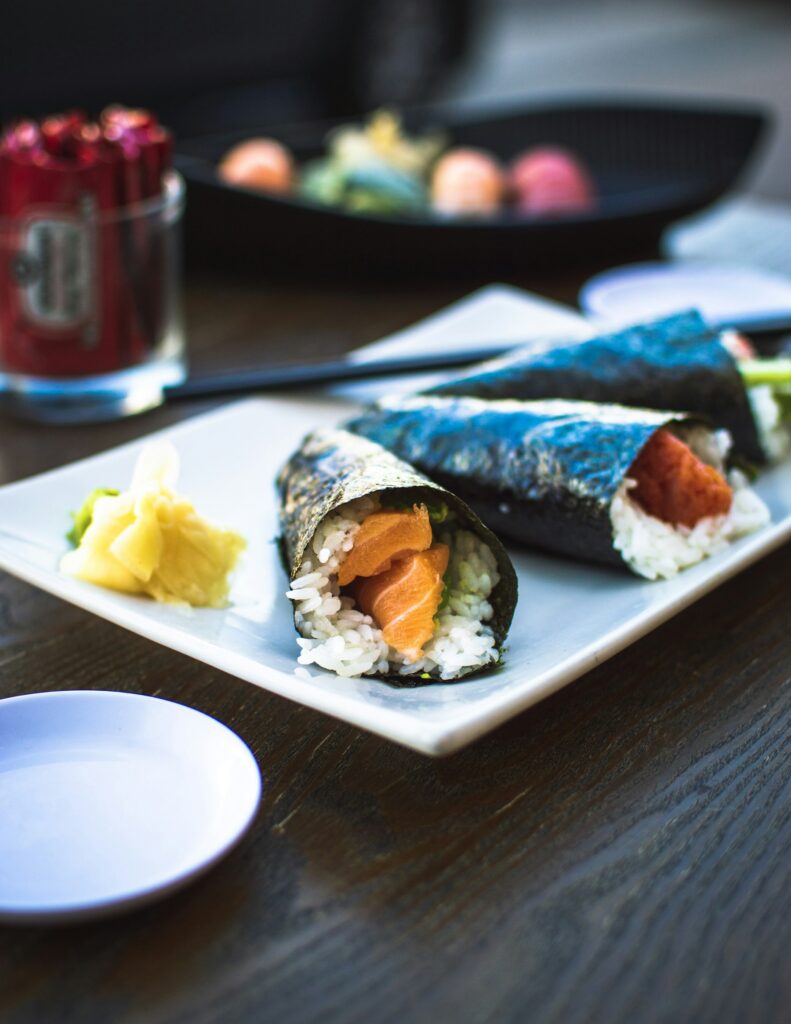
To make Temaki rolls, nori is wrapped around rice and fillings to form an ice cream cone shape hand roll.
- Yield
- 8 hand rolls
Directions
-
Pick up a half sheet of nori and, holding it shiny side down in the palm of your left hand
-
Dampen your right hand in the hand vinegar, scoop up a scant 1/4 cup of the rice, and gently press the rice onto the nori, leaving a half-inch border above and below the rice.
-
Use your index finger to press a vertical channel into the rice to hold the fillings.
-
Lay a combination of vegetables and/or egg in the channel.
-
Form the hand roll: Fold the bottom left corner of the nori with your right hand and snugly wrapping it around the rice and fillings while turning the hand roll to the right.
-
Continue wrapping and turning the roll to form an ice cream cone shape.
-
Seal the upper right corner of the nori with a bit of sushi rice.
-
Place the hand roll on a platter seam side down and continue with the remaining ingredients.
-
Add a teaspoon of tobiko (flying fish roe) on top if you aren’t purely vegetarian.
-
Alternatively, fill the hand roll with spicy tuna, salmon or any of your favorite fish garnished with diced green onion.
-
THE INGREDIENTS
-
Japanese-style rice: Japanese short-grain rice is the most essential ingredient in sushi making. High in starch, this short-grain rice gives sushi its characteristic stickiness when cooked (also makes it easier to eat with chopsticks). Sushi rice, like all grains, should be stored on a cool dark shelf in an airtight container.
-
Kombu: A type of kelp. This edible sea vegetable is one of the main ingredients in making dashi, the stock that is used throughout Japanese cuisine. The kelp is harvested from the cold water off Japan, and dried and sold in sheets at most Asian markets. The characteristic chalky appearance against the black-green sheets is a naturally occurring glutamic amino acid, a powerhouse of the flavor-enhancing taste umami.
-
Nori: Dried sheets of seaweed, nori is made by shredding edible seaweed, pressing it into thin sheets (much like the process for making paper) and drying, sold either plain or toasted. Nori is used to wrap sushi rolls, and it can also be shredded and served atop rice as a condiment and in miso soup. Make sure to keep nori dry and sealed until ready to use.
-
Pickled ginger (Gari): Usually served beside sushi, light pink pickled ginger is meant to be eaten by the slice in between eating different types of sushi to cleanse the palate and aid in digestion.
-
Rice vinegar: Japanese rice vinegar has a pale golden color and a subtle sweetness that allows the flavor of the rice to shine through. There are two types of rice vinegar: seasoned or unseasoned. Seasoned rice vinegar has added sugar and salt, often used in dipping sauce or for vinaigrettes. We use unseasoned rice vinegar in making sushi to control the seasoning of our syrup.
-
Sake: Distilled from polished and steamed rice grains, sake is an alcoholic beverage. When used in making sushi syrup, sake balances and enhances the flavors of sweet, sour and salty. It is also served both hot and cold to accompany sushi meals. For sushi-making purposes, using inexpensive sake is fine.
-
Soy sauce: Brewed from fermented soybeans, wheat, water and salt. It is used both as an ingredient and a dipping sauce for sushi. Tamari is a wheat-free (gluten free) and fragrant alternative to soy sauce.
-
Wasabi: Wasabi is a rhizome native to Japan. Genuine wasabi is expensive and rarely seen on restaurant menus in the United States. If you happen to come across it in a high-end sushi restaurant, you’re in for a treat; delicate and floral are words to describe the flavor of freshly grated real wasabi. Most wasabi found in Western markets is actually green-dyed mustard and horseradish powder. If using wasabi powder, make a stiff paste by mixing equal parts powder to water and let the mixture stand for 10 minutes to develop its flavor. Spicy, hot and pungent are just a few words to describe how powerful wasabi can be. Just a little is needed to smear in between fish and sushi rice. It is meant to enhance sushi and complement the ingredients, not overpower them.
-
TYPES OF SUSHI
-
Nigiri is an oblong mound of sushi rice that is pressed into the palm of the hand with a small dab of wasabi smeared on top and draped with a single topping. This sushi is meant to be eaten with your fingers. Place one piece of nigiri between your thumb and forefingers, turn it upside down, and dip the fish in the soy sauce. It is done this way because dipping it rice-side first will cause it to fall apart.
-
Maki is cylinder-shaped sushi rolls formed with the help of a bamboo mat, called a makisu.
-
Hosomaki is a thin cylinder-shaped roll with the nori on the outside. A typical hosomaki has a diameter of about 1 inch. It generally contains only one filling, often tuna, cucumber, eel, thinly sliced carrots, or avocado.
-
Futomaki is a large cylinder-shaped roll-formed with nori on the outside. Typical futomaki is about 2 to 2.5 inches in diameter. They are often made with two or three fillings that are chosen for their complementary flavors and colors.
-
Kappamaki is a variety of hosomaki filled with cucumber. Traditionally it is eaten to clean the palate between eating raw fish and other kinds of foods so that the flavors of the fish are distinct from the tastes of other foods.
-
Temaki, also called a hand roll, is a cone-shaped piece of nori filled with sushi rice with ingredients on the inside. It is by hand.
-
Uramaki is called an inside out roll. This medium-size cylinder shaped roll contains two or more fillings, and the rice is rolled on the outside with the nori inside. The filling is in the center surrounded by nori, then a layer of rice, and an outer coating of other ingredients such as tobiko (flying fish roe) or sesame seeds.
From Shawnie's class “Sushi at Home”